
Grant County Criminal Docket Searches
Figure out the court level first. For magistrate matters, the West Virginia Magistrate Case Record Search is the free public tool. It is known as MCR Search. No registration is needed. You can search by first name, last name, or case number, and the system caps results at 30 records. A case number beats a name here. Common surnames and spelling variants make name matches shaky. The docket search will not always tell you which person is yours. MCR also posts no document files online. A hit is usually just the first step toward requesting copies from the clerk.
Criminal cases that reach Circuit Court run through WVPASS instead. Registering and searching cost nothing, though downloading public documents carries a per-page fee. Sealed filings and juvenile cases stay out of the system entirely. When neither portal answers the question, contact the proper Grant County clerk directly by phone or in person.
- Read the notice and identify the court.
- Use MCR for Magistrate Court or WVPASS for Circuit Court.
- Enter the complete case number with punctuation.
- Compare court, charge, dates, and disposition.
- Request the docket sheet or certified order from the clerk.
Grant County Felony Docket Path
One felony can leave footprints in two Grant County courts. The complaint, warrant, initial appearance, bond, and preliminary proceeding usually happen in Magistrate Court. Circuit Court then takes the trial-level felony case. So a felony complaint found in MCR should prompt a second look for the later Grant County Circuit Court record. The two files may not share an identifier.
Keep the meaning straight. A preliminary hearing tests probable cause, nothing more. A transfer entry means just what it says. Indictments, pleas, trials, sentences, and dismissals show up in the circuit docket when those stages happened there. The Grant County docket search comparison helps you pick the right system.
Docket flow: Complaint › Initial Appearance › Bond › Preliminary Proceeding › Circuit Filing › Plea or Trial › Disposition
Criminal Dockets: What They Show
Think of a Grant County criminal docket as a dated activity log. It lists steps, not a narrative of every fact. MCR sorts its results into basic case information, charges, and bond data. It also lists event schedules, parties, and docket entries. That structure helps you tell an allegation from an order. It also separates a scheduled event from a finished result.
| Case ID | An identifier in a format such as ##-M##X-#####. |
|---|---|
| Case details | Style, filing date, type, agency, and court location. |
| Charge | Statute, plea, disposition, and disposition date when entered. |
| Bond | Type, set amount, posted amount, status, and dates. |
| Event schedule | Event, date, time, room, location, judge, and closure reason. |
| Docket entry | Filing date, code, description, and filing source. |
Codes you might see include MFFCF for a felony complaint and MMWAR for a warrant issued. Those two are examples, not a codebook. Read the description beside the code, and ask the clerk when one stays unclear.
Grant County Bond Docket Fields
"Bond set" and "bond posted" are two different Grant County criminal docket facts. MCR can show type, amount set, reduced amount, posted total, status, receipt number, and dates. An amount set by the court proves nothing. It does not show that anyone paid. And a posted entry does not mean the charge is over.
Bond set: the amount and conditions fixed by the court.
Bond posted: security was reported as provided.
Commitment order: a custody order, not a final outcome.
Release order: a custody change, not proof of dismissal.
Custody can shift after any docket entry. The Grant County Sheriff may hold booking and agency records, while the clerk holds complaints and orders. The county directory lists the Sheriff at 304-257-1818; the county publishes no official public Grant County jail roster.
Criminal Case Stages on the Docket
A Grant County criminal case often starts with a complaint or citation. A warrant may come next. Yet "warrant issued" does not prove service, arrest, or conviction. The initial appearance shows the accused came to court and heard notice of rights. Bond events and a preliminary hearing may follow. Some misdemeanors never leave Magistrate Court.
Circuit entries can include arraignment, motions, conferences, plea activity, trial, judgment, sentencing, and appeals. "Dismissed," "deferred," "bound over," and "convicted" each mean different things. Save the portal's exact term and date. If the trail stops after a preliminary stage, ask whether a separate circuit case number exists.
The official 2025 report counts 44 Grant County circuit criminal cases: 32 felonies, 3 misdemeanors, and 9 other criminal cases. Those numbers measure a year of court workload. They are not arrest, conviction, or pending totals.
Grant County MCR Search Limits
The judiciary MCR description confirms the search is free and statewide. It also states that document images are not provided online. The official entry screen can be shown without exposing any private person's result.
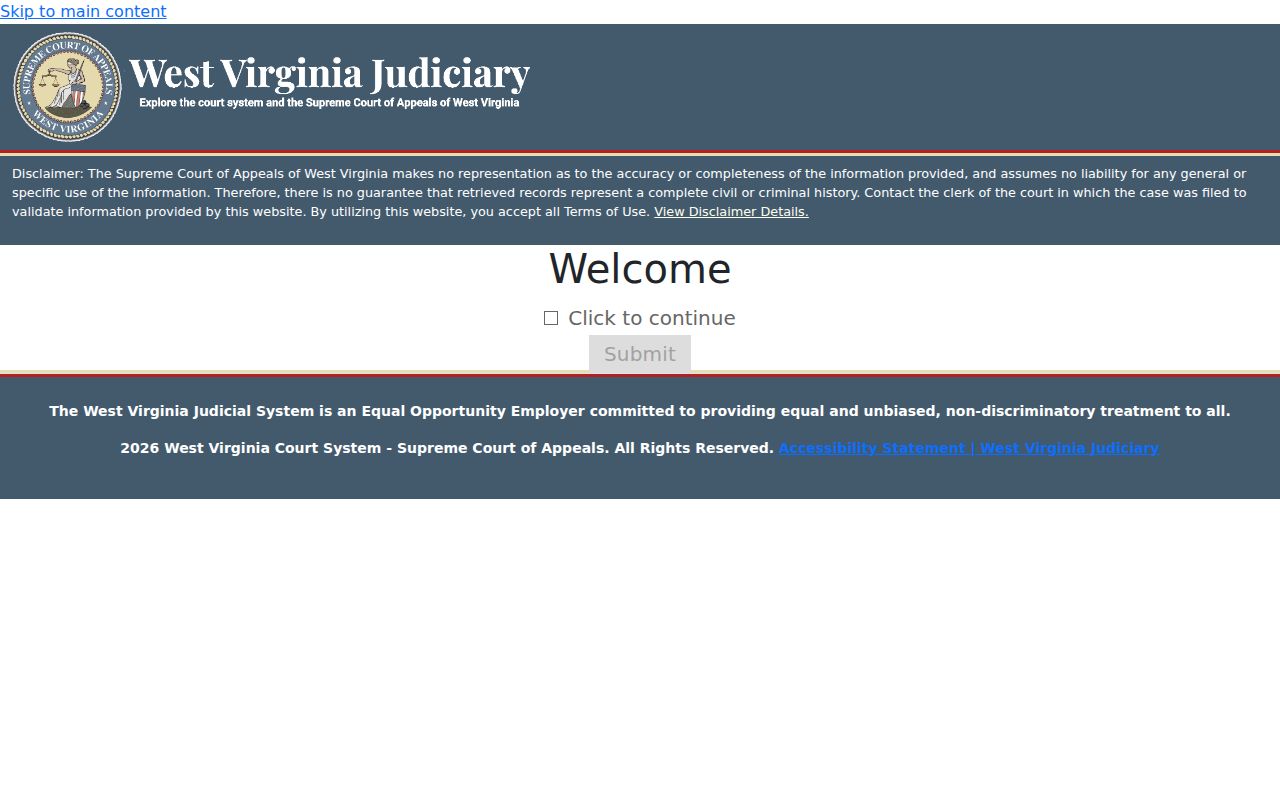
A 30-record cap does not prove only 30 matches exist. A blank result is not proof that no municipal, circuit, sealed, juvenile, federal, or older record exists either. Save the case number and location. Then validate important details with the clerk.
Grant County Criminal Docket Courts
Grant County Magistrate Court handles misdemeanors, felony preliminary work, warrants, and bonds. Magistrate Court Clerk Cheryl L. Bergdoll keeps those records at 4 North Main Street, Petersburg, WV 26847. The clerk number is 304-257-4637. The judiciary page also lists 304-257-1289 for magistrate-office routing. Confirm the right line before you call.
Grant County Circuit Court sits in the 25th Judicial Circuit alongside Mineral County. Circuit Clerk Melanie R. Redman holds its criminal pleadings, orders, and dockets at 5 Highland Avenue, Petersburg, WV 26847. The office is reachable at 304-257-4545. Judges list Keyser contacts too. The case notice and clerk confirmation control where you actually appear.
Sheriff reports, booking records, and jail status are separate matters. So is a Petersburg or Bayard ordinance case. Start municipal records with the city or town. That holds unless it confirms a state magistrate case or a circuit appeal.
Grant County Older Criminal Dockets
WVPASS went live on March 10, 2025. Its launch release points to public circuit documents going back to 1999. That starting point says nothing about older Grant County files. Plenty of paper still sits in the courthouse. For unscanned records and certified copies, the Grant County Circuit Clerk remains the office to call. Grant County joined CourtPLUS E-File on August 8, 2022. CourtPLUS and Vault run case management and authorized filing for the courts. Neither one replaces inspection at the clerk's counter. WVPASS is the public document route, and the e-file sign-on is not a general public search. When you request something, name it. A docket sheet, complaint, judgment, or sentencing order is easy for the clerk to pull. It is also easy to price. Give the court, case number, case style, date range, format you want, and whether you need certification. A blanket request for everything tied to a name costs more and moves slower.
Access Rules for Criminal Dockets
West Virginia Code §51-4-2 keeps court papers open to inspection. The same section requires clerks to furnish copies, except as otherwise provided. Trial Court Rule 10.04 backs that up, allowing information requests, inspection, copies, and electronic format through the custodian.
Protected records remain protected. Juvenile access is limited by §49-5-103. Sealed, confidential, and expunged records are not ordinary public files. Expungement under §§61-11-25 and 61-11-26 changes lawful access and should not be bypassed through another search.
CourtPLUS sorts filings into Public, Confidential-Low, Confidential-High, Sealed, and Expunged levels. A blocked document often reflects its legal status rather than a glitch. MCR can surface sensitive identifiers, so leave those details out of a broad request when the case number and court will do.
Grant County Criminal Docket Copies
Phone calls only go so far. The current Circuit Clerk Procedural Manual tells clerks to share open-file details like a date and time. It never requires staff to read a whole file aloud. Use a call to confirm the office holds the case, learn how copies are made, check a setting, and ask exactly which item to request. When the exact wording of a complaint, order, or judgment matters, go inspect the file or pay for a copy. MCR supplies data, not document downloads. Magistrate Administrative Rule 11 sets a 25-cent-per-page copy fee and a $2-per-page fax fee, subject to burden limits. Confirm the total and delivery method before you pay. WVPASS circuit downloads run 25 cents per page. The launch release adds a small card charge. That charge is not the same as a certified clerk copy. The clerk can quote the current certification cost. Ask whether it comes by mail or in person. Certification availability varies, so ask first. You can skip the prosecutor and probation offices for records. They are not neutral custodians. Go to the Magistrate Court Clerk or the Circuit Clerk for an official docket, judgment, or disposition. Pick whichever matches the court named in the case. West Virginia FOIA and a court-file request are not the same road. FOIA covers records of public bodies under its own definitions and exceptions. A Grant County court case belongs with the court custodian under the court-access statute and rules. The county's general web contact form can steer an unclear question. Treat it as a routing aid, not a formal court-record request form. Before any money changes hands, get the page count, certification charge, accepted payment, and delivery choice in writing. Keep the receipt with your docket or order. That keeps the source and request date clear.